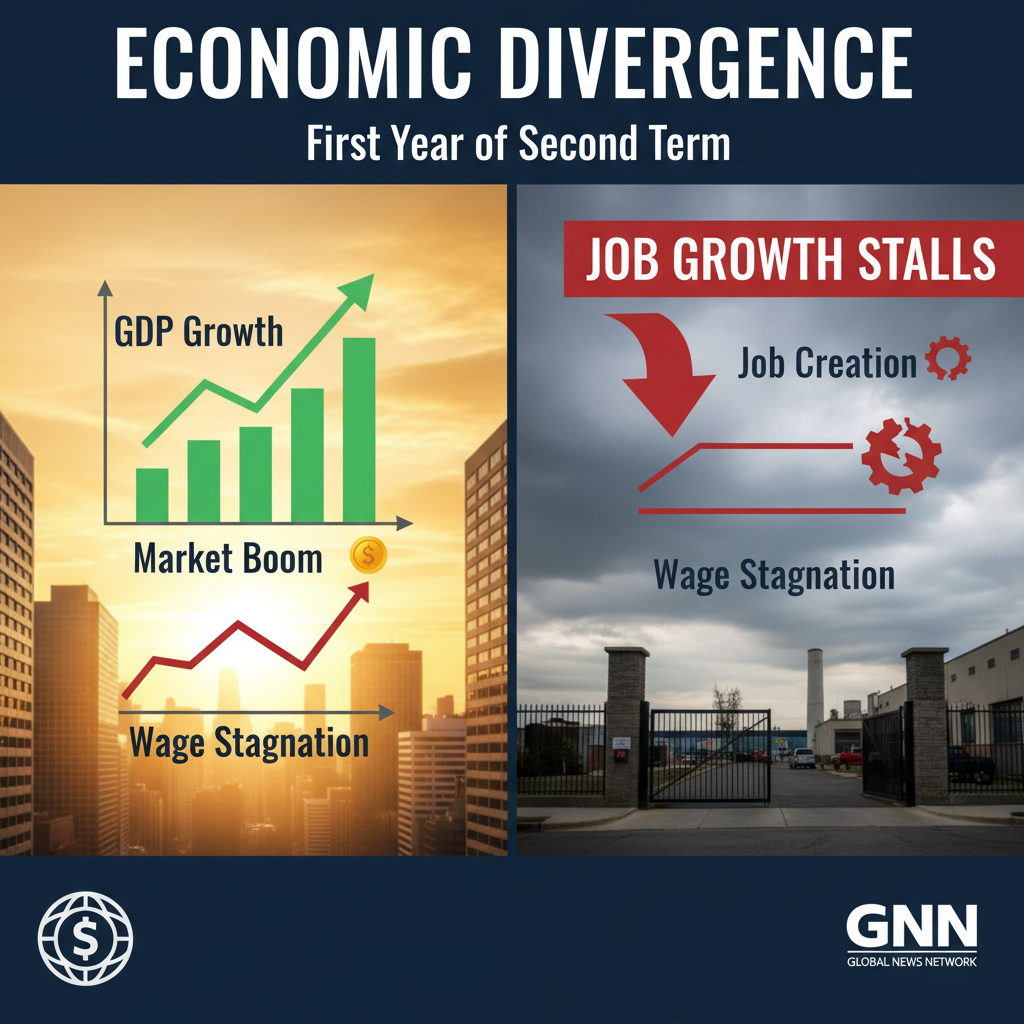
Rising Unemployment Signal Contradicts Record Market Valuations in Early 2026
A significant disconnect between economic indicators and stock market performance has emerged as of January 2026, financial analysts warn that a full percentage point rise in unemployment over the last year signals a looming recession despite the S&P 500 reaching near record highs.
Fiscal Volatility and Tariff Policies Shape Current Landscape
The current economic fragility follows a tumultuous 2025 characterized by extreme policy shifts and market reactions, the "Liberation Day" market crash in April 2025 erased trillions in global value following the implementation of aggressive import tariffs. Although markets eventually recovered due to the "One Big Beautiful Bill" Act signed in July, structural damage to supply chains remains evident, the subsequent stabilization measures created a complex environment where asset prices decoupled from fundamental economic health. This period of volatility set the stage for the current confusing signals where corporate valuations remain elevated while labor markets show distinct signs of cooling.
Analysts Identify Key Recession Indicators Amidst Market Greed
Financial experts are highlighting a specific 100 basis point increase in unemployment as a historically reliable predictor of economic contraction, market observer Rida Morwa describes this phenomenon as a slow motion crisis that investors are largely ignoring. The analysis suggests that while the broader market continues to chase artificial intelligence stocks and mega cap valuations, the underlying economy is weakening, this divergence has created a dangerous lack of safety margin for retirement portfolios. The Federal Reserve finds itself in a difficult position as it attempts to manage stagflation risks, the central bank faces limited options for interest rate cuts due to persistent inflationary pressure from tariffs.
Strategies Shift Toward Cash Flow and Undervalued Assets
Investment strategies are pivoting away from growth sectors that currently trade at multi decade highs, the recommendation focuses on securing income through high yield assets like Verizon and small cap funds. These sectors are viewed as offering value that has not yet been inflated by the post 2025 recovery rally, analysts emphasize that locking in reliable cash flow is critical before a potential correction occurs later in the year.
Retirees Face New Tax Incentives and Compliance Rules
Older Americans must navigate a limited window to maximize the new Senior Bonus Deduction which offers significant tax relief through 2028, a married couple can now utilize an additional $12,000 deduction which may effectively neutralize federal taxes on Social Security income. High income earners face stricter requirements regarding 401(k) catch up contributions which must now follow Roth after tax rules, younger generations will soon see the introduction of government seeded "Trump Accounts" aimed at long term savings starting in July 2026.
Economic planners urge caution as the federal deficit approaches $1.45 trillion, the convergence of high valuations and rising joblessness suggests that 2026 may require a defensive financial posture rather than aggressive expansion.