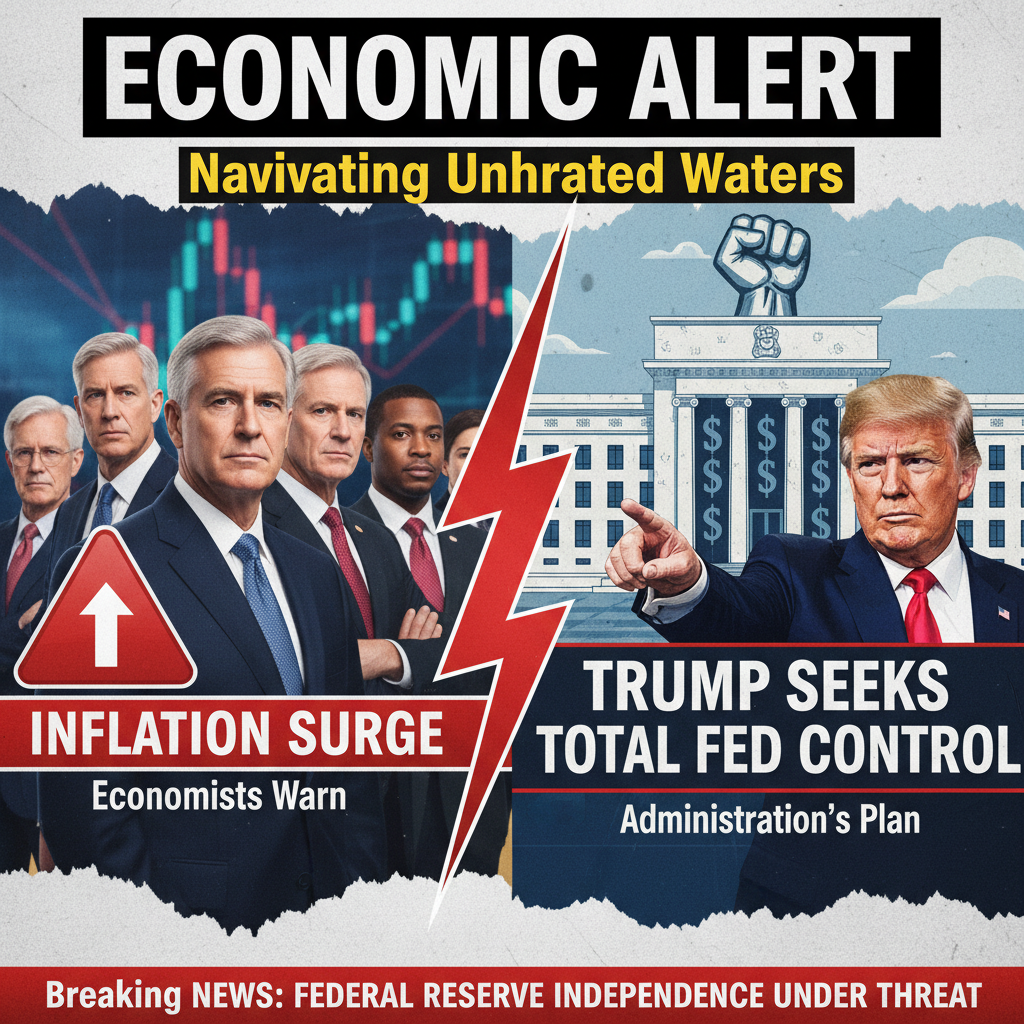
Economists Warn of Inflation Surge as Trump Administration Seeks Total Federal Reserve Control
President Trump is escalating his campaign to seize control of monetary policy by replacing Federal Reserve leadership with loyalists, this strategy aims to force aggressive interest rate cuts before the midterm elections. Financial experts caution that while this might trigger a temporary economic boom, it risks igniting a catastrophic inflationary spiral known as a sugar high.
Decades of Central Bank Independence Under Threat
The modern financial system relies on the 1951 Treasury Fed Accord which established the central bank's independence from political interference, this separation ensures that monetary decisions prioritize lasting stability over immediate electoral gains. The current conflict represents the most significant challenge to this structure in seventy five years, it coincides with the landmark Supreme Court case Trump v. Cook regarding the president's ability to fire board members. President Trump has frequently criticized Chair Jerome Powell since his first term, he views high interest rates as an impediment to rapid growth and seeks to align Fed policy directly with White House goals.
Administration Targets Powell and Vets Loyalists for Leadership
Pressure on the Federal Reserve has intensified significantly as the Department of Justice launches a controversial criminal investigation into Chair Jerome Powell, the probe officially centers on alleged mismanagement regarding a $2.5 billion headquarters renovation yet Powell describes it as a political pretext. Treasury Secretary Scott Bessent is simultaneously vetting candidates to replace Powell when his term expires in May 2026, the shortlist currently features former Governor Kevin Warsh as the frontrunner alongside other potential nominees like Christopher Waller and Michelle Bowman. The administration's explicit objective is to lower borrowing costs immediately to stimulate growth before the midterm elections, officials estimate that a single percentage point reduction could save $360 billion in federal debt service.
Experts argue that cutting rates while tariff policies keep inflation elevated creates a dangerous economic environment, this strategy threatens to decouple the dollar from market fundamentals and could trigger a scenario similar to the stagflation of the 1970s where growth stagnates while prices soar. Analysts warn that creating an artificial boom through rate cuts often results in a painful correction, this phenomenon forces central banks to eventually raise rates even higher to regain control over the economy.
Markets Face Volatility as Institutional Trust Erodes
Global investors are reacting nervously to the prospect of a politicized central bank, bond markets are showing signs of revolt with rising yields on ten year notes as traders price in future inflation risk. If the United States abandons its commitment to independent monetary policy, the dollar could lose its status as the world's primary reserve currency. Consumers might enjoy temporary relief on loan rates, yet they face the deeper threat of rapidly rising prices for essential goods.
The President is expected to announce his nominee for Fed Chair near the upcoming Davos summit, this decision will signal whether the administration intends to prioritize immediate market euphoria over lasting economic stability.